Selecting the right Gummy Tin Box supplier requires more than comparing unit prices. Global buyers need dependable materials, consistent decoration, and documented food-contact compliance. A box may look attractive online, yet its inner coating, lid fit, or printing quality can fail during long-distance transport.
Industry data supports this growing opportunity. Grand View Research valued the global metal packaging market at approximately USD 135 billion in 2023, with continued growth expected through 2030. Mordor Intelligence also estimates that the confectionery packaging market will expand steadily during the same period. These reports indicate stronger demand for durable, reusable, and visually distinctive packaging. Gummy Tin Box products fit this direction, especially for seasonal gifts, retail counters, and premium brand launches.
The best suppliers combine manufacturing experience with transparent quality systems. Buyers should review tinplate thickness, coating specifications, migration testing, color consistency, and closure performance. Certifications such as ISO 9001, BRCGS Packaging Materials, or relevant food-contact documentation can provide useful evidence. However, certificates alone are not enough. Request production samples. Test the hinge, edges, odor, and stacking strength.
Supplier location also matters. Confirm tooling charges, minimum order quantities, lead times, carton protection, and export records before placing a large order. Small details matter. A slightly loose lid can damage brand perception.
This guide compares leading Gummy Tin Box suppliers for global buyers. It considers capability, customization, communication, and reliability. The assessment is practical, but not perfect. Supplier performance can change, and published information may become outdated. Independent verification remains essential.
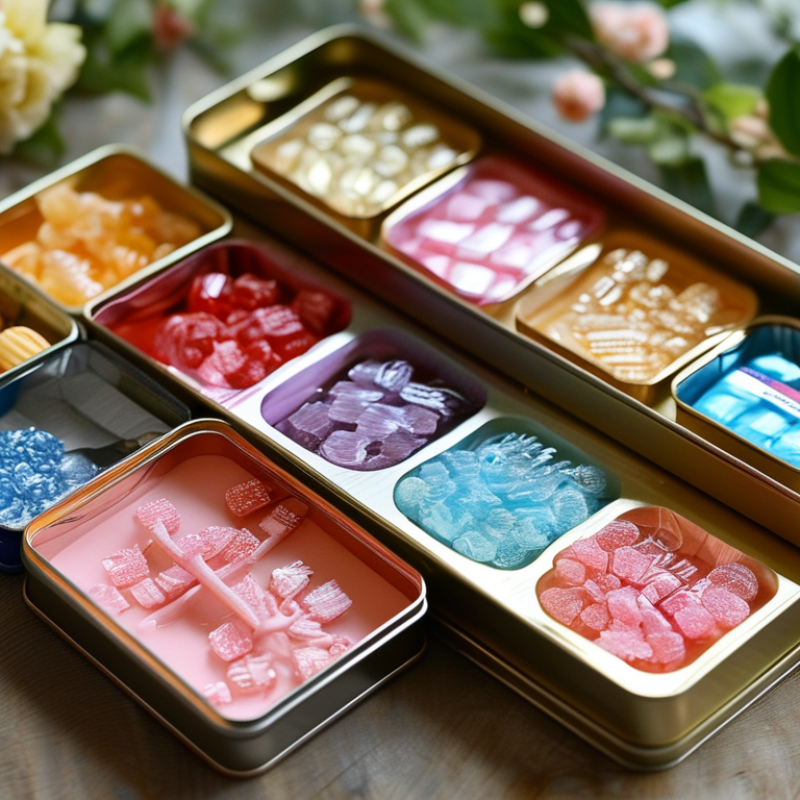
Gummy tin boxes are compact metal containers designed to hold gummy candies securely. They usually use tinplate steel with a food-contact lining and a fitted lid. Unlike flexible pouches, a tin box keeps its shape in retail displays, luggage, and kitchen drawers. A 60-gram box may fit several gummies without crushing them, though capacity depends on each candy’s shape. Rounded corners matter when consumers carry the package.
Global buyers choose these boxes for protection, presentation, and repeat use. The rigid shell helps resist pressure, light, and minor moisture exposure. It also supports printed artwork, embossed details, and reusable storage after the gummies are gone. For importers, this second life can improve perceived value without requiring a complex closure. Reliable suppliers should provide material declarations, coating information, dimensional drawings, and sample approval records. Buyers should check lid fit after transit testing. A beautiful sample means little if the lid loosens in a warm container.
From packaging work, I have found that small details create the biggest delays. A hinge can look precise but fail after repeated opening. An inner tray may protect gummies yet reduce the saleable fill weight. I once underestimated humidity’s effect on label adhesion. That mistake changed how I review supplier samples. Request production samples, carton drop tests, and clear food-contact documentation before placing a large order. Compare minimum order quantities, lead times, and print tolerances, not only unit price. Supplier performance varies by project.
Top Gummy Tin Box Suppliers for Global Buyers?
How to Evaluate Gummy Tin Box Suppliers Worldwide
Choosing a gummy tin box supplier requires more than comparing prices. A polished catalog can still hide a weak factory. Request recent audit records, food-contact declarations, coating specifications, and production photos. Check whether the supplier controls tinplate sourcing, printing, forming, and final inspection. Ask for samples with the exact dimensions, hinge style, lacquer, and closure. A sample made by hand may not represent mass production.
Packaging performance needs practical testing. Measure lid fit, edge sharpness, coating adhesion, odor, and resistance to humidity. For export orders, request carton drop tests and stacking results. APEAL’s 2023 Activity Report recorded an 80.5% steel packaging recycling rate in Europe in 2022. This supports recyclable steel packaging, but recycling claims still depend on local collection systems. Smithers’ metal-packaging outlook also highlights lightweighting and recyclability as major industry priorities.
Tips: Compare suppliers using the same checklist. Confirm minimum order quantity, tooling ownership, lead time, replacement policy, and payment terms. Ask for a pilot run before a large shipment. Verify batch codes and inspection records. I would not rely only on certificates; documents can be outdated. Visit the factory, if possible, or arrange an independent inspection. Small details matter. A loose lid or metallic odor can damage customer trust quickly.
| Evaluation Dimension | Suggested Weight | Reliable Benchmark or Requirement | Evidence Global Buyers Should Request | Why It Matters for Gummy Packaging |
|---|---|---|---|---|
| Food-Contact Compliance | 20% | Packaging materials should comply with the regulations applicable in the destination market, such as EU Regulation 1935/2004 EU GMP Regulation 2023/2006 or applicable United States food-contact requirements under 21 CFR. | Current declaration of compliance, migration-test results, material specifications, coating information, and a documented list of destination markets served. | Gummy products may contact internal coatings, seams, inks, or protective finishes during storage and transport. |
| Material and Construction | 15% | The supplier should clearly identify the substrate, tinplate or steel grade, metal thickness, internal coating system, lid construction, and closure type. Specifications must remain consistent between samples and mass production. | Technical data sheet, material certificate, coating declaration, cross-section details, and approved production sample. | Correct construction affects durability, stackability, corrosion resistance, lid fit, and product protection. |
| Product Safety and Hygiene Controls | 15% | A documented food-safety management system is preferred. Recognized systems may include HACCP or certification to a recognized food-safety standard such as ISO 22000, where appropriate to the operation. | Valid certificates, audit reports, hygiene procedures, traceability records, pest-control procedures, and corrective-action documentation. | Helps reduce contamination, foreign-material, odor, and traceability risks in food-contact packaging production. |
| Printing and Decoration Quality | 10% | The supplier should control color consistency, print registration, coating adhesion, surface finish, barcode readability, and resistance to rubbing or handling. | Color proof, production sample, color-control method, rub-resistance test, barcode verification, and inspection criteria with acceptance limits. | Decorative quality strongly influences shelf appeal and reduces rejection caused by scratches, color shifts, or misalignment. |
| Tooling and Customization Capability | 10% | The supplier should provide a defined process for custom shapes, embossing, debossing, windows, specialty finishes, and lid tolerances. Tooling ownership and reuse terms should be written into the contract. | Engineering drawings, prototype samples, tooling quotation, tolerance table, tooling-life information, and written ownership conditions. | Clear tooling terms prevent disputes and support repeat orders for seasonal or campaign-specific gummy tins. |
| Quality Assurance and Inspection | 10% | A documented inspection plan should cover incoming materials, printing, forming, assembly, dimensions, closure performance, surface defects, and final packing. | Quality-control plan, inspection report template, sampling method, defect classification, corrective-action process, and retained-sample policy. | Consistent inspection reduces defects such as sharp edges, loose lids, dents, coating damage, and poor stacking. |
| Capacity, Lead Time, and Delivery Reliability | 10% | Production lead time should be stated separately for tooling, sampling, first production, and repeat orders. The supplier should disclose capacity constraints during peak seasons. | Written production schedule, historical on-time-delivery data, capacity statement, peak-season plan, packaging timeline, and shipment documentation. | Reliable scheduling is important for holiday launches, promotions, contract manufacturing, and inventory planning. |
| Minimum Order Quantity and Commercial Terms | 5% | Minimum order quantity, tooling charges, sampling fees, payment terms, price validity, and cost changes caused by material or specification changes should be transparent. | Formal quotation, incoterm, payment schedule, tooling invoice, price-break structure, and written terms for cancellations or specification changes. | Transparent commercial terms make it easier to compare suppliers and calculate the true landed cost. |
| Export Packaging and Logistics | 3% | Finished tins should be protected against abrasion, moisture, deformation, and movement during international transport. Carton dimensions and pallet configuration should be documented. | Export-carton specification, pallet plan, loading photographs, drop or compression-test records where applicable, and shipping marks. | Proper packing reduces dents, scratches, moisture exposure, and freight-related claims. |
| Sustainability and Recyclability | 2% | Steel and tinplate are widely recyclable materials. Buyers should verify the actual material composition, coating system, recycled-content claims, and applicable environmental declarations. | Material composition statement, environmental certifications where applicable, recycled-content evidence, packaging-weight data, and recycling guidance for the target market. | Verified environmental data supports responsible sourcing and helps avoid unsupported sustainability claims. |
For global buyers, a gummy tin supplier should offer more than attractive packaging. Manufacturing control matters from sheet selection to final inspection. Ask whether the tin uses food-contact compliant materials and documented coatings. Request test reports, batch records, and clear traceability. Small details matter. A loose lid can damage gummies during transport.
Customization should begin with practical measurements. Share the gummy size, filling weight, and stacking method before approving artwork. A reliable manufacturer can recommend tin dimensions, wall thickness, hinge strength, and protective inserts. Common options include embossed logos, matte or glossy finishes, spot colors, and printed interiors. Color matching needs a physical proof, not only a digital screen.
Sampling reveals production ability better than a sales presentation. Check the lid fit, edge smoothness, odor, print alignment, and resistance to light scratches. The first sample may still need revision. That is normal, but repeated errors signal weak process control. Confirm minimum order quantities, tooling charges, replacement policies, and realistic lead times in writing. Suppliers should also explain carton testing, pallet protection, and export documentation. Factory audits or live production checks can add confidence, especially for unfamiliar facilities. A low unit price can become expensive when molds, delays, or rejected cartons are excluded. Reliability is measured after approval, not during the first quotation.
Which manufacturing and customization services matter most?
The chart uses a normalized 0–100 buyer-priority index to compare the manufacturing and customization factors commonly evaluated when sourcing gummy tin boxes internationally. Food-contact compliance, print quality, closure performance, and tooling support are especially important for reliable global procurement.
Quality, safety, and compliance standards can differ sharply between gummy tin box suppliers. A reliable supplier should control steel thickness, lid fit, seam strength, and surface finish.
In production checks, a loose lid often reveals poor tooling or rushed assembly. Small details matter.
The inner coating must suit direct food contact and resist oil, moisture, and acidic ingredients. Ask for migration test reports, coating specifications, and ink safety documents.
Testing should cover the finished tin, not only the raw sheet. That distinction is easy to miss.
Suppliers serving different markets may follow separate food-contact rules, labeling expectations, and documentation systems. A certificate accepted in one region may not satisfy another authority.
Safety also includes physical design. Inspect sharp edges, loose hinges, paint flakes, and small detachable parts.
Request samples from regular production, rather than specially prepared samples. Check odor after opening the tin. It can be surprisingly informative.
Lot codes, inspection records, and corrective-action reports show whether a supplier manages problems professionally. Some suppliers provide impressive paperwork but weak traceability.
Buyers should question gaps politely and verify key claims through independent laboratories. Compliance is not a single badge; it is an ongoing process involving materials, manufacturing, testing, and market-specific records.
When comparing gummy tin box suppliers, do not judge price from a single unit quote. Ask what the quote includes: tinplate thickness, lid style, printing, inner coating, tooling, and packing. A low price can hide setup charges. Request a sample with the same dimensions and artwork. Inspect hinge movement, edge smoothness, odor, and closure strength. Small defects become expensive during filling and transport. I have found that written specifications prevent more confusion than attractive catalog photos. Still, samples do not always reflect a large production run.
Minimum order quantities deserve a practical calculation. A supplier may offer a lower unit cost at 10,000 pieces, but excess stock can tie up cash and warehouse space. Compare three levels, such as 1,000, 5,000, and 10,000 units. Ask whether mixed colors or sizes count toward one MOQ. Confirm mold fees, repeat-order terms, and payment stages. For seasonal products, a smaller first order may be safer. It may cost more per tin.
Shipping quotes should show more than a total amount. Check production lead time, port or airport options, carton dimensions, gross weight, insurance, and customs responsibilities. Sea freight may suit stable, large orders, while air freight supports urgent replenishment. Ask for both door-to-door and port-to-port pricing. Verify food-contact declarations and export documents before payment. Delays often come from missing paperwork, not manufacturing. Build a realistic buffer. My comparison sheets once missed local handling fees, so I now request a landed-cost estimate in writing.
: Request recent audit records, food-contact declarations, coating details, and production photos. Compare suppliers with the same checklist. A polished catalog proves very little.
Ask for migration tests, ink safety documents, coating specifications, and inspection records. The reports should cover the finished tin, not only raw steel sheets. Documents can become outdated.
Check lid fit, edge smoothness, hinge movement, odor, and coating adhesion. Test the tin under humidity and light handling. A handmade sample may not match factory production.
Inspect sharp edges, loose hinges, paint flakes, and detachable small parts. Open several tins and check for metallic odors. It can be surprisingly informative.
Request regular-production samples, batch codes, inspection records, and corrective-action reports. A pilot run can reveal tooling or assembly problems before a large shipment. Small details matter.
Request carton drop tests, stacking results, and humidity-resistance checks. Confirm the planned carton size and packing method. Packaging can fail during transport.
Confirm minimum order quantity, tooling ownership, lead time, replacement terms, and payment conditions. Ask who controls the tooling if the supplier changes. This detail is easy to overlook.
Steel packaging is widely recyclable, but results depend on local collection systems. Ask for clear material information instead of trusting broad environmental claims. I would not rely on one certificate alone.
A Gummy Tin Box is a durable, reusable packaging solution designed to protect gummy products while improving presentation, portability, and shelf appeal. Global buyers often choose tin boxes because they offer strong protection against crushing, moisture, light, and contamination when properly sealed. They can also be customized with different shapes, sizes, colors, finishes, closures, and printed designs to support product positioning and customer convenience.
When evaluating suppliers worldwide, buyers should review manufacturing experience, communication efficiency, customization capabilities, sampling procedures, and production capacity. Quality and safety are equally important, including food-contact materials, reliable coatings, accurate dimensions, secure lids, and compliance with the destination market’s packaging requirements. Buyers should compare unit prices together with minimum order quantities, tooling fees, sample costs, lead times, payment terms, and shipping methods. A dependable supplier should provide transparent quotations, consistent quality control, appropriate documentation, and flexible logistics solutions for both trial orders and long-term purchasing.

CR Tin